Send it within 24 hours, keep it under 150 words, mention one specific thing from the conversation, and do not grovel. That is the entire playbook. Surveys of hiring managers consistently find that most expect a thank-you note and some hold silence against candidates, yet the majority of applicants never send one, which makes this the cheapest edge in the process.
Below: the rules in brief, then eight templates you can adapt in two minutes.
The rules that matter
Within 24 hours, ideally the same day. The note should arrive while the interviewer still remembers the conversation. Next morning is fine; three days later reads as an afterthought.
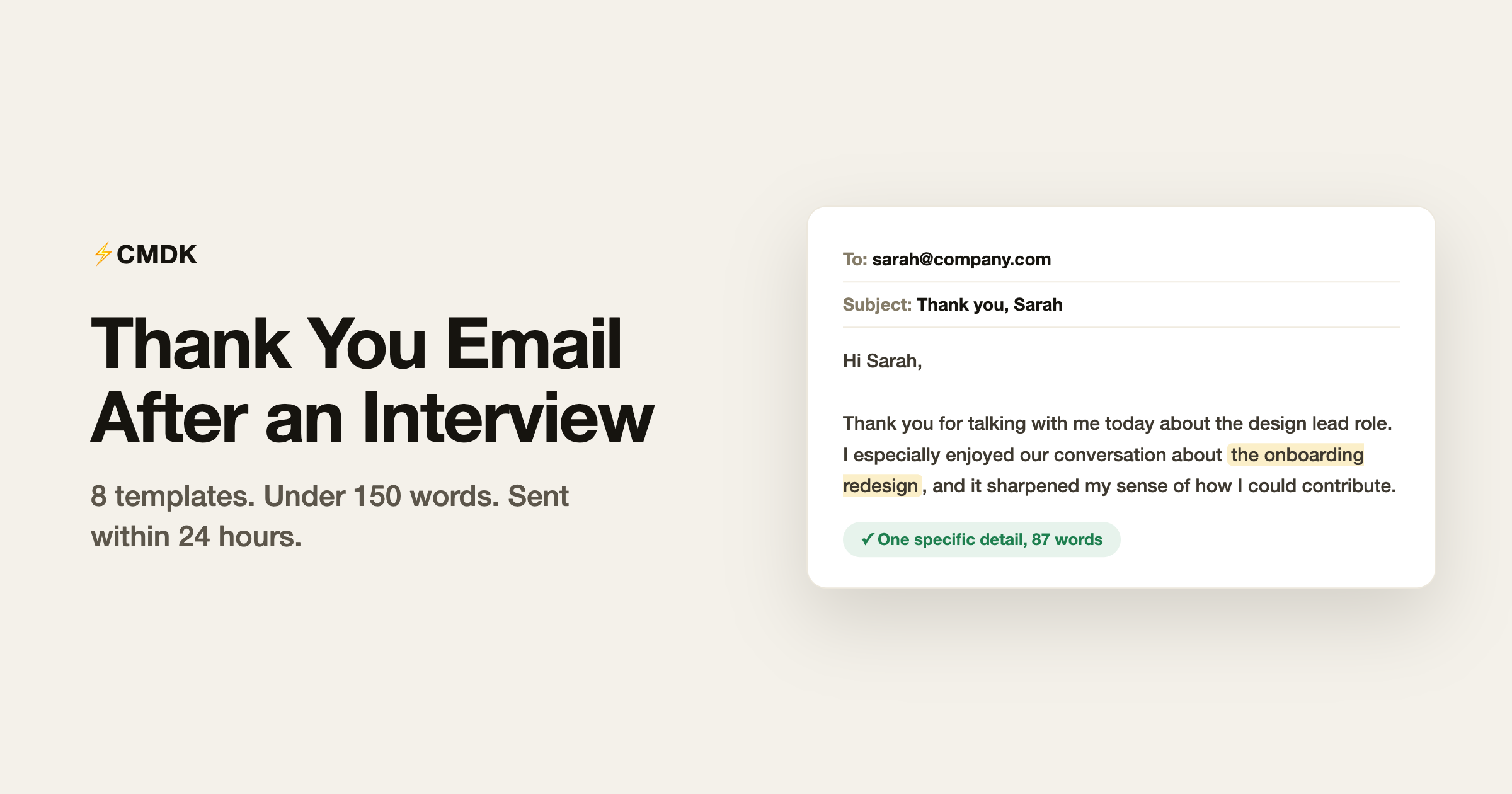
One specific detail. A note that could have been sent to any company after any interview is worth little. Reference something discussed: a project they mentioned, a challenge the team is facing, a question that made you think.
Short. 100 to 150 words. The interviewer has a job that is not reading your mail. Three short paragraphs: thanks, the specific detail plus why you are a fit, forward-looking close.
Everyone who interviewed you. Panel of four means four emails, each with a different specific detail. Interviewers compare notes; identical notes are worse than none.
Send it by email. The paper thank-you letter is dead outside a few old-school industries. Email arrives while the decision is still open.
Template 1: the standard note
Subject: Thank you, [Interviewer name]
Hi [Name],
Thank you for taking the time to talk with me today about the [role] position. I especially enjoyed our conversation about [specific topic], and it sharpened my sense of how I could contribute, particularly on [relevant skill or project].
The role sounds like exactly the kind of work I want to be doing, and the team came across just as well as the job description promised.
Happy to share anything else that would be useful. Looking forward to next steps.
Best,
[Your name]
Template 2: after a panel interview
Send each panelist their own note. Vary the middle paragraph:
Hi [Name],
Thank you for being part of the panel today. Your question about [topic] stayed with me; I gave a partial answer in the room, and on reflection I would add [one-sentence better answer].
I enjoyed meeting the whole team and left even more interested in the role than when I arrived.
Best,
[Your name]
The “better answer” move turns a weak moment into a demonstration that you keep thinking after the meeting ends.
Template 3: after a phone screen
Shorter, because the interaction was shorter:
Hi [Name],
Thanks for the call today. Our conversation about [topic] confirmed my interest in the [role] role, and I hope the fit looked as good from your side.
Happy to provide anything else you need for the next stage.
Best,
[Your name]
Template 4: after a second or final round
Hi [Name],
Thank you for the deeper look at the team and the roadmap today. Hearing about [specific project or challenge] made the role concrete in a way job descriptions never manage, and I am confident my experience with [relevant experience] maps directly onto it.
Whatever the outcome, I appreciated the thoroughness of the process. I hope to hear from you soon.
Best,
[Your name]
Template 5: when you want to add something you forgot
Hi [Name],
Thank you for today’s conversation. One thing I meant to mention when we discussed [topic]: [the thing you forgot, one or two sentences].
It was a pleasure meeting you, and I am looking forward to hearing about next steps.
Best,
[Your name]
Template 6: after an interview that went badly
Do not pretend it went well; recover the one thing worth recovering:
Hi [Name],
Thank you for your time today. I do not think I did justice to your question about [topic], so here is the answer I should have given: [two-sentence answer].
I remain very interested in the role and would welcome the chance to continue the conversation.
Best,
[Your name]
Template 7: to the recruiter or coordinator
Hi [Name],
Thank you for organizing today’s interviews; the day ran smoothly and everyone I met was generous with their time. The conversations confirmed my interest in the role.
Please pass on my thanks to the team, and let me know if you need anything else from me.
Best,
[Your name]
Template 8: the follow-up when you hear nothing
Sometimes the thank-you note needs a sequel. If the stated timeline passes in silence, wait two or three business days beyond it, then send a short check-in. The full playbook for that, including timing and templates, is in our follow-up email guide.
Hi [Name],
When we spoke on [date] you mentioned hearing back by [date]. I wanted to check in and see whether there is any update on the [role] position.
I remain very interested. Happy to provide anything else that would help.
Best,
[Your name]
Sending several of these? Save the skeleton
If you are interviewing at multiple companies, you will write this same email a dozen times in a month. Save the skeleton once as a snippet in CMDK and insert it with a semicolon trigger in Gmail, then personalize the bracketed parts. The structure stays consistent; the details stay specific. The same trick works for starting emails and sign-offs.
FAQ
How soon should I send a thank you email after an interview?
Within 24 hours, ideally the same day. Same-day notes arrive while the conversation is fresh; anything past two days suggests the interview was not memorable for you either.
How long should an interview thank you email be?
100 to 150 words: a line of thanks, one specific detail from the conversation tied to why you fit, and a forward-looking close. Longer notes dilute the signal and cost the reader time.
Should I send a thank you email to every interviewer?
Yes, individually, with a different specific detail in each. Interviewers frequently compare notes, and identical copy-paste messages read worse than sending nothing.
Do thank you emails actually matter?
They rarely win an offer alone, but they break ties and their absence is noticed. Some hiring managers treat no note as a signal of low interest. Ten minutes of writing for a meaningful tie-breaker is the best time-to-impact ratio in the process.
What if I forgot to send one and it has been three days?
Send it anyway, without apologizing for the delay. A good note on day three beats silence forever. Fold in a forward-looking reason to write: a thought on something discussed, or a question about next steps.
Interviewing means sending the same three emails again and again: thanks, follow-up, scheduling. CMDK turns each into a snippet you insert in Gmail with a keystroke, and its read receipts tell you when the recruiter actually opened your note. Install it free.