The start of an email has two parts people conflate: the greeting (one line of politeness) and the opening line (where you earn the read). Most advice obsesses over the greeting, but readers decide whether to keep reading at the first sentence. Get the greeting adequate and the first line specific, and the email works.
The rule for greetings: match how well you know the person, and when unsure, err one notch more formal; nobody was ever offended by “Hi” with their name. The rule for openings: say why you are writing in the first sentence. Everything below is variations on those two rules, sorted by situation.
Greetings: the safe defaults
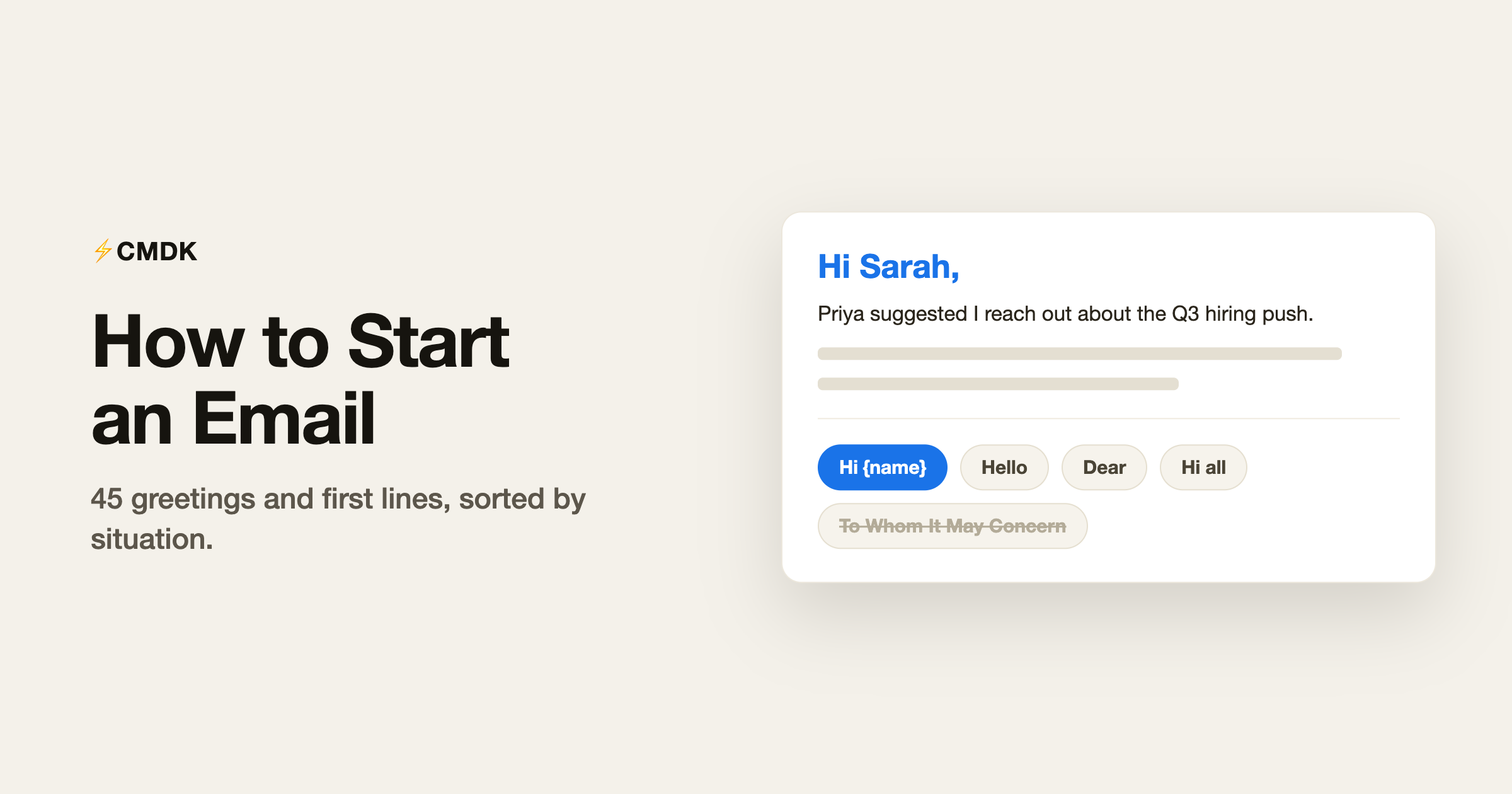
- Hi {name}, – the modern business default, correct in nearly every context
- Hello {name}, – one notch more formal, still warm
- Hey {name}, – colleagues and people you talk to often
- Dear {name}, – formal: first contact with senior people, applications, official matters
- Hi both, / Hi all, / Hi team, – two people, groups, and teams respectively
- Good morning / Good afternoon {name}, – warm and slightly formal, if you know their timezone
For names: use the first name in almost all business email. Use “Dear Mr./Ms. {surname}” only in formal first contact, legal or academic correspondence, or cultures and industries where titles are the norm; drop to first names as soon as they sign with theirs.
Greetings to retire
- To Whom It May Concern – the strongest “I did no research” signal in email. Find a name, or address the team (“Dear hiring team”).
- Dear Sir or Madam – same problem, older costume.
- Hi there, – reads as mail-merge fallback, because it usually is.
- Gentlemen, – retired for reasons that should not need explaining.
- No greeting at all – fine deep inside a fast thread, abrupt as an opener.
Opening lines for cold outreach
The reader’s only question is “why me, why you, why now”. Answer it immediately:
- {Mutual contact} suggested I reach out about {topic}.
- I saw your talk at {event} and had a question about {specific point}.
- Congratulations on {specific recent thing}; it prompted this email.
- I noticed {company} is hiring three SDRs, which usually means {relevant pain}.
- I will keep this short: we help {their role} do {outcome}, and I think it applies to {company}.
The anti-patterns: “I hope this email finds you well” (the reader’s delete finger twitches), “My name is X and I work at Y” (your signature says that), and any paragraph about your company’s founding story.
Opening lines for follow-ups
Do not re-litigate the whole history; point at it once and ask the question:
- Following up on the below: any thoughts?
- Wanted to bring this back to the top of your inbox.
- Since we spoke last week, {new development}, which changes the timeline.
- Closing the loop here: should I keep this open or park it?
If you send follow-ups often, the real fix is upstream: reminders that resurface threads when they go unanswered, so the follow-up goes out on schedule instead of when guilt strikes.
Opening lines for internal email
Colleagues do not need warming up; they need the point and what you want from them:
- Quick one: can you approve the Q3 budget line by Thursday?
- Heads up: the deploy moved to Monday, no action needed.
- Decision needed by Friday: option A or B below.
- FYI only, context for tomorrow’s standup.
“Quick one”, “Heads up”, “Decision needed”, and “FYI only” are load-bearing labels: they tell the reader the size and type of the ask before they read another word.
Opening lines for difficult emails
Bad news, apologies, and disagreement earn a direct start; padding reads as evasion:
- I am sorry, we made a mistake with {thing}, and here is what happened.
- The launch is slipping by two weeks. Here is why, and the new plan.
- I see this differently, and I want to lay out my reasoning.
- Before this hardens into a decision, I want to flag two risks.
Replying: skip the greeting theater
Inside an active thread, drop the greeting entirely or keep just the name. “Hi again” and re-greeting someone every message in a same-day exchange reads as odd. The reply’s opening line should connect to their last message: “That works”, “Good catch, fixed”, “Two answers below”. Email threads are conversations; write the reply like the next thing you would say.
Stop retyping your openers
If you write the same greeting-plus-opener combinations daily (outreach, follow-ups, intro replies), they belong in snippets. CMDK’s snippets expand a short trigger into a full opener with placeholders for the name and the specific detail, so the personalization survives and the typing does not. And once the start is right, how to end an email covers the other bookend.
Frequently asked questions
What is the best greeting to start an email?
“Hi {first name},” is the standard for business email in 2026: warm, professional, and appropriate in almost every context. Use “Dear {name},” for formal first contact and “Hey” only with people you already talk to casually.
How do you start an email to someone you don’t know?
“Hi {name},” followed by a first line that says why you are writing to them specifically: a referral, something they published, a specific relevant observation. The greeting matters less than proving in the first sentence that the email was written for them.
Is “I hope this email finds you well” bad?
It is harmless but wasted: it carries no information, and its overuse in cold email has made it a skip signal. Replace it with your actual reason for writing, or with something genuinely specific (“Hope the launch went well last week”).
How do you start an email to multiple people?
“Hi both,” for two people, “Hi all,” or “Hi team,” for more. If actions differ by person, name them in the body (“Maya: the numbers. Raj: the deck.”) so nobody assumes the other owns it.
Should I use “Dear” in a business email?
Use “Dear” for formal situations: applications, first contact with senior people, legal and official correspondence, and formal cultures. In day-to-day business email it now reads slightly stiff; “Hi” or “Hello” is the working standard.
Write the opener once, reuse it forever: CMDK turns your best openings into Gmail snippets with placeholders for the name and detail, free for 15 days.