Most email statistics pages recycle the same numbers from the same reports. This one does that too, with two differences: every figure below is traced to a primary source with its year attached, and the middle of this page contains numbers you will not find anywhere else, drawn from anonymized, aggregate usage data from CMDK, our Gmail extension.
The short version:
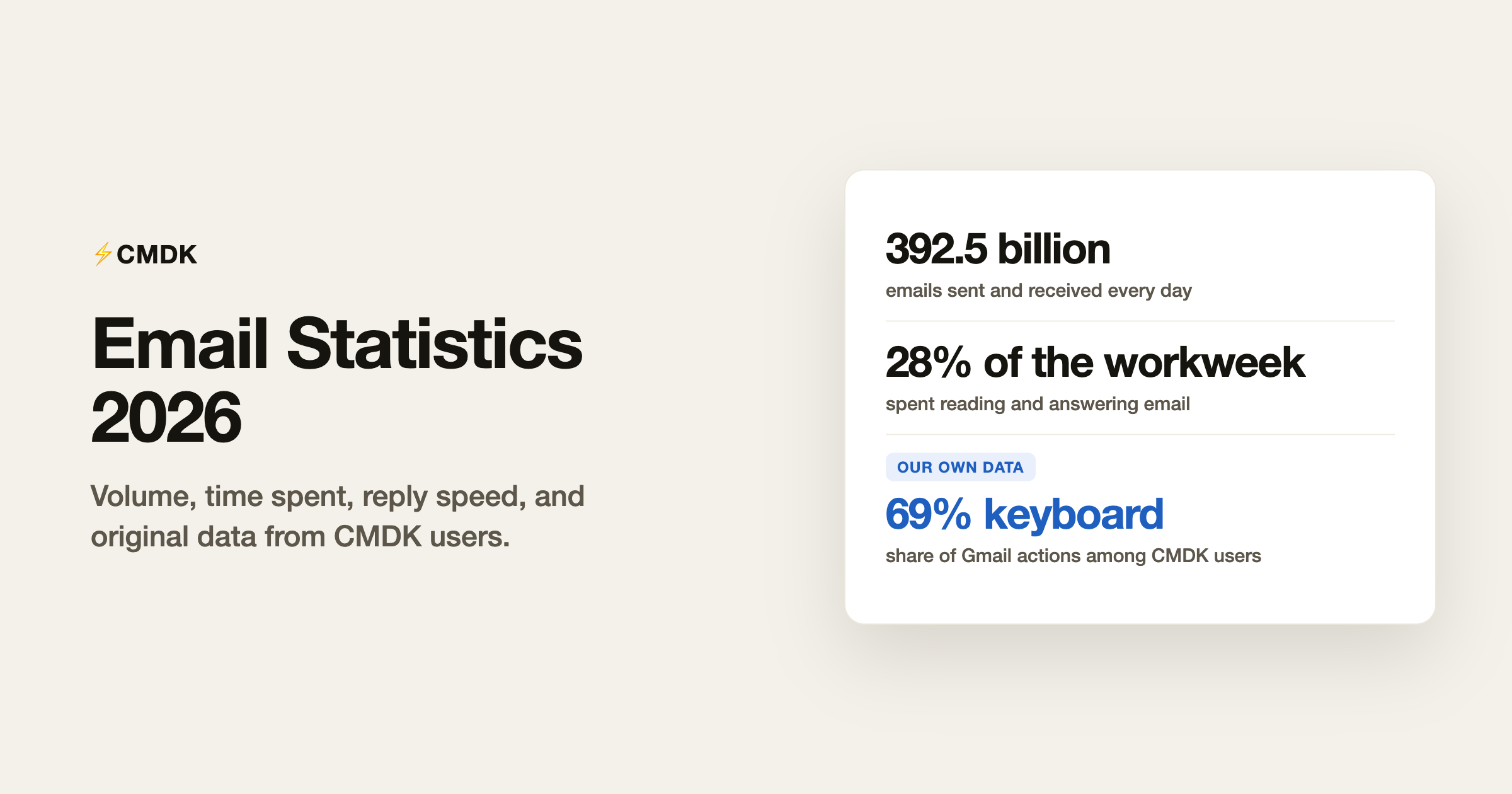
- 392.5 billion emails are sent and received every day in 2026 (Radicati Group)
- The average worker receives 117 emails a day and spends 28% of the workweek on email (Microsoft, McKinsey)
- The average reply takes 12 hours 55 minutes to arrive (EmailAnalytics)
- In our own data, 69% of Gmail actions among CMDK users happen on the keyboard, and 29% of email activity falls outside 9 to 6
How many emails are sent per day?
An estimated 392.5 billion emails are sent and received per day in 2026, according to the Radicati Group’s Email Statistics Report, the long-running industry benchmark for email volume. The forecast reaches 408.2 billion by the end of 2027.
The growth is remarkably steady, at roughly 4% a year for nearly a decade:
- 2022: 333.2 billion per day
- 2023: 347.3 billion per day
- 2024: 361.6 billion per day
- 2025: 376.4 billion per day
- 2026: 392.5 billion per day
- 2027: 408.2 billion per day (forecast)
That works out to about 4.5 million emails every second. Messaging apps, Slack, and Teams were all supposed to kill email. Instead email absorbed them as notifications and kept growing.
How many people use email?
Around 4.7 billion people use email in 2026, about 58% of the world’s population (Radicati, Statista). Email remains the only universal digital identity: every app, bank, and government portal still assumes you have an address.
Gmail’s share of that:
- Roughly 1.8 billion people use Gmail
- Gmail accounts for about a quarter of all email opens across devices, second only to Apple Mail, whose reported share is inflated by Apple’s Mail Privacy Protection auto-loading tracking pixels
- Among browser-based email, Gmail’s share is about 86%, which is why everything we build targets Gmail in the browser
How much time do we spend on email?
This is where the numbers become a cost.
- The average professional spends 28% of the workweek reading and answering email, about 2.6 hours a day, per the McKinsey Global Institute’s analysis of knowledge worker time
- The average worker receives 117 emails per day, alongside 153 Teams messages, per Microsoft’s 2025 Work Trend Index, which analyzed trillions of Microsoft 365 signals
- Workers are interrupted 275 times a day by meetings, emails, and chat, roughly once every two minutes during core hours (Microsoft)
- After an interruption it takes an average of 23 minutes and 15 seconds to fully refocus, per Gloria Mark’s long-running research at UC Irvine
- Computer-logging studies at UC Irvine found workers check email 74 to 77 times per day, and 41% of those checks are self-interruptions with no notification involved
Microsoft’s report also documented what it calls the infinite workday: 40% of workers check email before 6 AM, and 29% are back in their inbox by 10 PM. Our own data below broadly confirms this pattern from a completely independent vantage point.
How fast do people actually reply?
Expectations and reality are far apart:
- The average reply time across 22 industries is 4 hours 10 minutes counting work hours only, and 12 hours 55 minutes in elapsed time, per the EmailAnalytics benchmark of 25.4 million emails in Q2 2026
- Meanwhile, surveyed expectations run far ahead of that: client-facing emails are expected to be answered within 2 hours, and sales inquiries within minutes
The practical takeaway: if you have not heard back within a day, send a structured follow-up. At a 13-hour average reply time, your email is sitting in someone’s deferred pile, and follow-ups are how replies get retrieved from it.
What CMDK users do differently: our own data
CMDK is a Gmail extension used heavily by people who live in email: founders, sales, support, and operators. That makes our aggregate usage data a window into how email power users actually behave.
Methodology, so you can judge the numbers: the figures below come from standard, anonymized product analytics (which feature was used, when), deduplicated at the event level and reported in aggregate over a recent 30-day window. We never analyze email content, subject lines, or recipients. The cohort skews toward keyboard-leaning Gmail power users, which we note wherever it matters.
69% of Gmail actions happen on the keyboard
Over the 30-day window, CMDK users performed 221,610 actions via keyboard shortcut versus 100,187 with the mouse, a 68.9% keyboard share by volume. Usage is unevenly distributed: about a quarter of users execute three-quarters or more of their Gmail actions entirely by keyboard, while the median user is still mostly mouse-driven.
The gap between the median and the volume-weighted share tells its own story: the more email you process, the more the keyboard wins. If you want to move in that direction, start with our Gmail shortcuts cheat sheet.
29% of email activity happens outside 9 to 6
Normalizing each user’s activity equally, 28.7% of Gmail actions happen outside 9 AM to 6 PM local time. More than half of users (54.6%) show meaningful evening activity after 6 PM, 52.3% are active on weekends, and 23.9% show pre-6 AM activity.
That is Microsoft’s infinite workday finding reproduced in a non-Microsoft dataset: the boundary between work hours and email hours has mostly dissolved for heavy email users.
The snooze button is a to-do list
Among 8,574 snoozed emails over 90 days, the destinations are strikingly consistent: about 17% snooze to tomorrow and 9% to Monday, with “next week” close behind. The median snoozer defers about 3 emails a week.
Heavy snooze users treat the inbox as a scheduling system: an email that arrives today gets a decision today, even if that decision is “Monday”. It is the same deferred-reply behavior the 13-hour average reply time points to.
Marketing email benchmarks in 2026
For completeness, the numbers marketers usually mean when they say email statistics:
- Average marketing open rate: around 21%, though Apple’s Mail Privacy Protection inflates reported opens by several points, so engagement-adjusted figures run closer to 17%
- Click-to-open rate: 6.8% (MailerLite, across 3.6 million campaigns)
- Unsubscribe rate: 0.22% per campaign in 2025, nearly triple the 0.08% of 2024, a jump MailerLite attributes largely to Gmail’s Subscription Management Center making unsubscribing one click
That unsubscribe surge matters even if you never send a newsletter: Gmail made leaving easy, and subscribers are using it.
Spam, noise, and subscription fatigue
- Roughly 45% of all email traffic is spam, around 170 billion messages a day (Statista). The good news: that share is down from a peak of 86% in 2014, because filtering improved faster than spammers did
- Only 24% of received emails are relevant and important to the recipient, per Adobe’s Email Usage Study
- The average person maintains 20 to 30 newsletter subscriptions, and 62% of newsletter readers admit they do not read most of what they receive (Pew Research Center, 2025)
- 70% of consumers unsubscribed from at least one sender in the past three months because of volume
If your own inbox is the case study here, that is fixable in an afternoon: our Gmail cleanup guide and guide to stopping spam cover the whole process.
Sources and methodology
Third-party figures come from primary sources: the Radicati Group’s Email Statistics Report (2023-2027), Microsoft’s Work Trend Index (2025), McKinsey Global Institute, Gloria Mark’s research at UC Irvine, Pew Research Center (2025), MailerLite’s benchmark report (2025), the EmailAnalytics Q2 2026 benchmark, Adobe’s Email Usage Study, and Statista. Where sources disagree, we cite the more conservative figure and say so.
CMDK figures are computed from standard, anonymized product analytics over a recent 30-day window: which feature was used and when, reported in aggregate. Medians are reported alongside averages where the distribution is skewed, and cohort sizes are stated with each stat. No email content, subject lines, or recipient information is ever analyzed.
This page is refreshed quarterly. Figures were last verified in July 2026.
Frequently asked questions
How many emails are sent per day in 2026?
About 392.5 billion emails are sent and received per day worldwide in 2026, according to the Radicati Group. Volume has grown roughly 4% a year for a decade and is forecast to pass 408 billion daily emails by the end of 2027.
What percentage of emails actually get opened?
For marketing campaigns, the cross-industry average open rate is around 21%, and engagement-adjusted figures run closer to 17% once Apple’s Mail Privacy Protection inflation is accounted for. Person-to-person email performs far better: write to a real person about something relevant to them and the odds are strong they see it the same day.
How much time does the average person spend on email?
The most-cited figure is McKinsey’s: 28% of the workweek, about 2.6 hours a day. Microsoft’s 2025 telemetry puts the average worker at 117 emails received per day, checked dozens of times, with 40% of workers checking email before 6 AM.
How long does it take people to reply to an email?
The average reply takes 4 hours 10 minutes of work time, or 12 hours 55 minutes elapsed, per EmailAnalytics’ Q2 2026 benchmark of 25 million emails. Expectations run much shorter: surveys put the expected turnaround for client-facing email at under 2 hours.
How much of all email is spam?
Roughly 45% of global email traffic is spam, around 170 billion messages per day. Most of it never reaches an inbox thanks to filtering, which is why the practical problem for most people is gray mail: legitimate newsletters and promotions they no longer read.
Want your own numbers to look like these? CMDK adds read receipts, keyboard-speed triage, and snooze to Gmail, so you can see who opened, act in one keystroke, and defer the rest on purpose.