The end of an email does two jobs: it sets the tone the reader leaves with, and it tells them what happens next. “Best” does the first job and skips the second. “Talk Monday at 3” does both. Most sign-off mistakes are just a mismatch between how well you know the person and how the closing sounds.
The rule that covers 90 percent of cases: match the formality of the greeting you opened with, and if you need something from the reader, say it in the last line before you sign off. The 60 options below are grouped by situation so you can grab one and move on.
The safe defaults
These work in almost any work email. When in doubt, pick from this list.
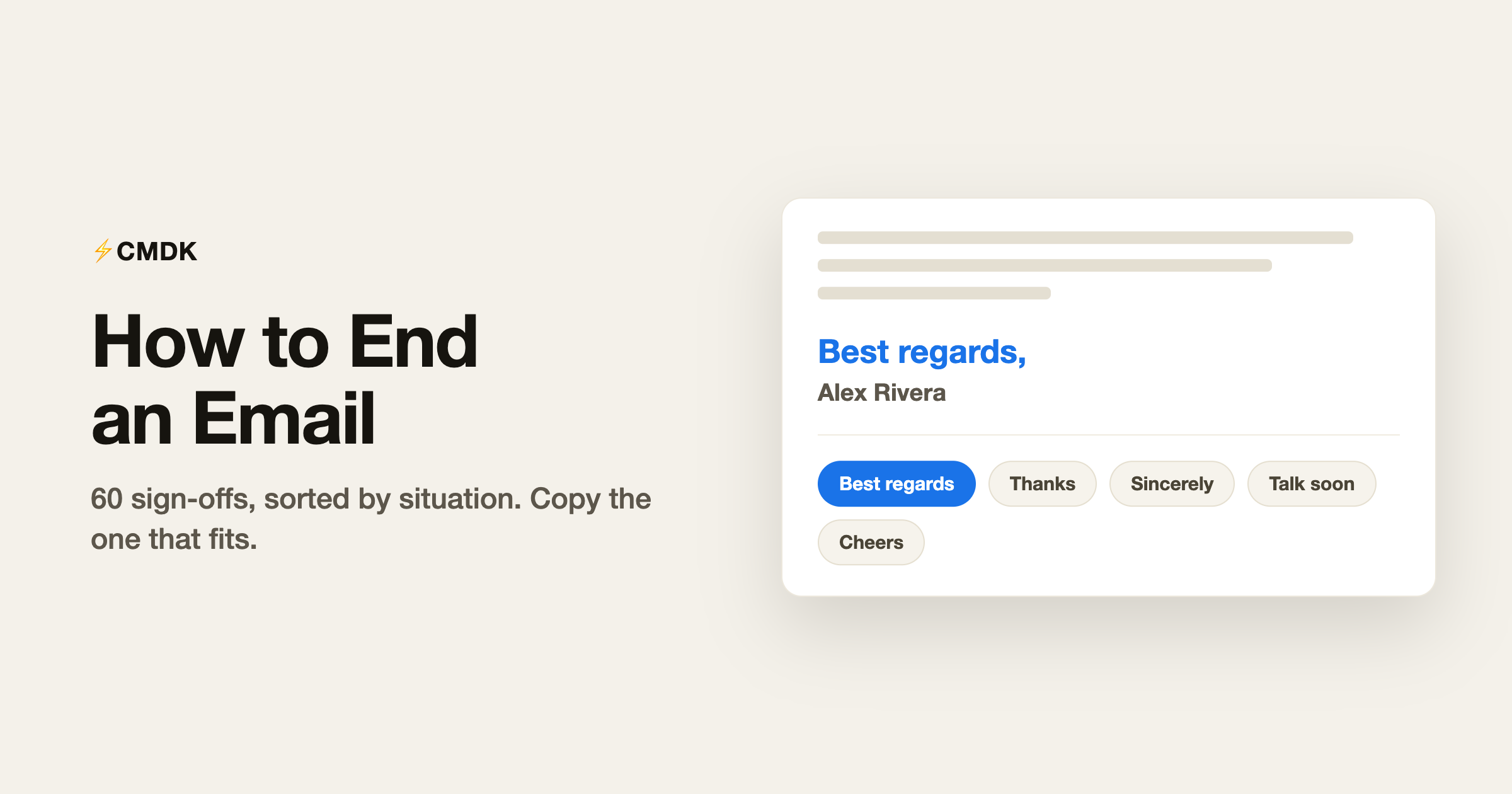
- Best regards
- Best
- Regards
- Thanks
- Thank you
- All the best
- Kind regards
- Many thanks
“Best regards” is the most neutral option in English business email. “Thanks” is the most common overall, and it fits any email where the reader is doing something for you.
Professional but warmer
For colleagues and clients you already work with, where “Kind regards” feels stiff.
- Have a great week
- Enjoy the weekend
- Talk soon
- Speak soon
- Looking forward to it
- Great working with you on this
- More soon
- Onward
Formal sign-offs
For first contact with senior people, legal or financial correspondence, and anywhere a mistake would be expensive.
- Sincerely
- Respectfully
- Yours sincerely (UK, when you opened with a name)
- Yours faithfully (UK, when you opened with Dear Sir or Madam)
- With appreciation
- With gratitude
Sincerely is rarely wrong in formal email. The UK pair has a rule: sincerely when you know the name, faithfully when you do not.
Ending a follow-up email
The sign-off carries more weight in a follow-up because the whole email is a nudge. Pair a short closing line with a plain sign-off.
- Any thoughts on the below?
- Happy to close this out if it is no longer relevant.
- No rush, just keeping it on your radar.
- Should I check back next week, or is this dead?
- Bumping this to the top of your inbox.
- If someone else owns this now, point me to them and I will stop bothering you.
Then sign with “Thanks” or “Best”. The closing line does the work; the sign-off just ends it. If your follow-ups keep slipping through the cracks, set a Gmail reminder that resurfaces the thread instead of relying on memory.
Saying thank you
- Thanks so much
- Thanks for your help with this
- Thanks in advance (only when they have already agreed to help)
- I appreciate it
- Really appreciate your time today
- Grateful for the quick turnaround
“Thanks in advance” divides people: it reads as presumptuous when you are asking for something new, and perfectly fine when the person has already said yes. Use it accordingly.
After an apology or bad news
Keep the ending quiet. An upbeat sign-off after bad news reads as tone-deaf.
- Thank you for your patience
- Thanks for understanding
- I appreciate your flexibility
- Sincerely
- Again, my apologies for the mix-up
Cold outreach
The goal is to sound like a person who remembers the last email. Formal endings hurt here.
- Worth a quick chat?
- Open to a 15-minute call next week?
- If this is not relevant, feel free to ignore me.
- Either way, keep up the good work with {company}.
- Cheers
Friendly and casual
For teammates you talk to every day, and anyone you would text.
- Cheers
- Thanks!
- Later
- Have a good one
- See you Thursday
- 🙂 (yes, alone, and only internally)
Sign-offs to avoid
- Xoxo, Love, Hugs: personal life only.
- Thx, Rgds: saves you half a second and costs you more than that in how it reads.
- Sent from my iPhone: doing sign-off duty in far too many emails. Replace it with a real signature.
- V/R or other initialisms: fine inside the military, opaque outside it.
- Nothing at all: acceptable deep in a fast-moving thread, abrupt anywhere else.
The line before the sign-off matters more
A sign-off cannot rescue an ending that does not say what happens next. Before “Best,” add one of these if the email needs action:
- Could you send the file by Thursday?
- I will follow up Friday if I have not heard back.
- No action needed, just keeping you in the loop.
- Let me know if Tuesday works and I will send an invite.
The pattern: one sentence that names the action, the owner, and the date. Then any sign-off works.
Stop typing the same ending twice a day
If you write the same closing lines over and over, they belong in a snippet. CMDK’s snippets expand a short trigger into your full closing (line, sign-off, signature) anywhere in Gmail, with placeholders for the name and date. Your sign-off stays consistent and costs zero keystrokes.
Frequently asked questions
What is the most professional way to end an email?
“Best regards” followed by your name is the most broadly professional ending in English. “Sincerely” is the formal option for first contact or serious correspondence, and “Thanks” fits any email where the reader is doing something for you.
How do you end an email asking for something?
Name the action and the deadline in the last line, then sign off plainly: “Could you confirm by Thursday? Thanks, Alex.” The request line matters more than the sign-off.
Is “Best” too informal?
No. “Best” is the shortened form of “Best regards” and is standard in business email. It only reads as curt in very formal contexts, where “Sincerely” is the safer pick.
Should I end an email with just my name?
In an ongoing thread with someone you know, yes, a name alone is fine. In a first email or anything formal, add a sign-off line above it.
What is a gender-neutral alternative to “Dear Sir or Madam” endings?
If you opened generically, close with “Yours faithfully” (UK) or “Sincerely” (US). Better: find a name or use the team (“Dear hiring team”), then close with “Best regards”.
Write the ending once, reuse it forever: CMDK turns your best closings into Gmail snippets that fill in the name and date for you.